Friday, October 7, 2016

31 Days of Horror- Day 7: They Look Like People (2016)

(dir. Perry Blackshear)


While staying in New York with an old friend, a man hears a voice in his head that convinces him the world is being taken over by demons disguised as humans.

They Look Like People is constantly unnerving, and yet it’s horror is understated, primarily based on what we don’t see and punctuated by moments of heartbreaking humanity based on the goodness of human beings. The horror then stems from the possibility that this goodness is an illusion, a performance put on by sinister forces that only look like people. But the title of the film works both ways when we consider the plight of our lead character Wyatt, and his secret collection of weapons, and plans to kill those creatures. As the film goes on and we begin to doubt Wyatt’s conviction, we realize that we may not be watching the story of a demon hunter but of a possible serial killer in the making. Serial killers don’t look like the monsters horror movies have propagated, they look like people, as ordinary and unseen as the faces we pass daily. What’s scary is that we sympathize with Wyatt, we like him, and understand that these possible voices in his head are not the result of evil but of his own potential mental illness that has taken away his ability to distinguish fantasy from reality.

Macleod Andrews’ performance as Wyatt is filled with quiet dignity, one at odds with the more outgoing personality of his friend Christian, whose charismatic performance by Evan Dumouchel adds a certain lightness that only creates more unease in the longrun. Both Wyatt and Christian put on outward personas to disguise their true selves, and the film’s examination of mental illness leaves them both revealed by the end of the film, an end that I’d imagine won’t be what many are expecting. But the beauty and horror of They Look Like People, is that is that it ultimately is about people, stripped down to look like exactly what they are.

Scare Factor: 4/5 A cross between Frailty and Take ShelterThey Look Like People builds tensions masterfully, leaving most of the horror to exist in expertly placed sound design. This is of the finest dramatic horror films in recent years, proof that horror can still be at its most creative when it’s operating on a miniscule budget and focused on interpersonal relationships in confined spaces.

*Available to watch on Netflix Instant

Thursday, October 6, 2016

31 Days of Horror- Day 6: Deathgasm (2015)

(dir. Jason Lei Howden)

Dark Sky Films
A teenage heavy metal enthusiast unknowingly summons a demon and turns the residents of his small town into soulless minions after a playing a black hymn in the hopes of finding some control over his life.

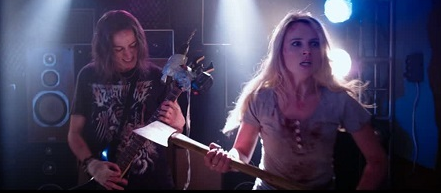
Heavy metal and horror has become an inseparable pairing, what with all the Satanist icons, high-fantasy monsters, and lyrics of pain, suffering, and demon slaying. Jason Lei Howden’s Deathgasm taps into all of this in a film that both celebrates and satirizes the relationship between metal and monsters. Taking a page from Sam Raimi’s Evil Dead series, Deathgasm finds humor in the extreme levels of blood, gratuitous violence, and sexual references. Every moment of horror is a visual gag of some sort, an offering to the history of heavy metal and cinematic depictions of demonology. But between the buckets of blood, disembowelments, severed members, and improvised weaponry there’s a beating heart of optimism.

Deathgasm’s likeable leads do wonders for this film, elevating the material beyond exploitation and finding truth in the isolation and outsider identity that so many teenagers face. Milo Cawthorne, James Blake, and Kimberely Crossman not only give their characters distinct, yet recognizable character traits, they do so while balancing genuine humor and emotion. Their respective characters, Brodie, Zakk, and Medina give the film a surprising poignancy that doesn’t just exist between the moments of spewing blood and tangles of entrails but carries through it, adding weight to a style of horror that’s typically weightless. Deathgasm will have you cheering for its lead characters, it’s copious amounts of gore, and wishing more films could succeed so effortlessly at creating feel-good horror from traditionally feel-bad aesthetics associated with bloodbaths and heavy metal.


Scare Factor: 1/5 Deathgasm isn’t frightening but it’s an utter blast to watch, and for fans of gore and heavy metal it’s a triumphant horror film that will leave you begging for a sequel.

*Available to watch on Netflix Instant
Wednesday, October 5, 2016

31 Days of Horror-Day 5: Lights Out (2016)

(dir. David F. Sandberg)

Warner Bros.
A young woman, Rebecca, attempts to save her family from a mysterious entity that thrives on darkness and holds a special connection to her mother.

Lights Out operates around an unsubtle metaphor for depression, but the fact that the film’s themes are apparent don’t make it any less successful a horror movie (i.e. The Babadook). Where Sandberg’s film differs from so many recent studio horror films is that it actually cares about its characters. Call this the James Wan effect, but the days of expendable characters for the sake of horror beats are nearly gone. Not only does Mario Bello give a strong performance of a woman battling severe depression, but the film actually takes time to explore the effects of her mental illness on herself and her family, giving Bello’s performance time to take hold and allow the allegorical nature of the film to feel fully explored. We’re rooted in the reality of something very costly and personal before the film takes off, preventing the film from feeling like it’s exploiting mental illness. Instead, Lights Out seeks to understand the effects of severe depression and isolation and achieves this through a monster.  
Much of what makes David F. Sandberg’s Lights Out work as well as it does is the design of the entity, Diana. Like The Ring’s Samara over a decade ago, Diana’s uncanny form and movements give the scares in Lights Out plenty of mileage. There’s never a moment in the film where Diana’s appearance isn’t jolting, even though these burst of adrenaline become less successful once we’re given a full look at her face. But for most of the film’s runtime, Diana’s purity of design has all the makings of a horror icon.

Sandberg cleverly uses light and darkness to create some of the film’s most effective moments and visual gags. Diana can’t attack her would-be victim in the light, so Sandberg has fun playing with power outages, flashlights, lighters, and cell phones to create a cat and mouse game that’s worthy of the film’s supernatural set-up. Lights Out never becomes particularly shocking but it’s a hell of a ride that’s an absolute blast to watch with a crowd.

Scare Factor: 4/5 Lights Out is one of the more successful studio horror films of the past few years, which should come as no surprise given James Wan’s involvement. What is surprising is to see first-time feature director David F. Sandberg’s to act with such visual assuredness that more mainstream horror films could certainly use. This is classic keep the lights on horror that not only keeps in spirit with the season but offers something a little deeper for those who want more character-focused mainstream horror.

Tuesday, October 4, 2016

31 Days of Horror- Day 4: Green Room (2016)

(dir. Jeremy Saulnier)

A24

A punk-rock band fights for their lives against an army of skinheads.

Jeremy Saulnier’s previous film, Blue Ruin, was one of the most surprising films of 2014 in its authentic depiction of violence and revenge. With Green Room, Saulnier finds that same authenticity in the horror genre, so much so that I nearly hesitated to call it a horror film upon first viewing. Within the genre there’s often a separation between reality and fantasy, even in the most grounded of horror movies there’s comfort to be found in the fakery of it all. But Green Room is visceral to the point of deep-seated discomfort. It’s extremely gory, yes, but Green Room is not an exploitation film because there’s no distance from the violence. Where many other filmmakers would pull away from the acts of violence and allow it to happen off-screen, Saulnier looks directly at it, not only concentrating on the wounds inflicted but the pain of the characters at the mercy of their injuries. This is horror violence not made for enjoyment, but depicted to expose the nihilistic soul of modern America.

Green Room doesn’t just use punk music for the sake of a soundtrack, but allows it to exist within the very bones of the film. America is a nightmare, and punk music captures the discordant chaos of it all. There’s an unmistakable feeling of displacement for our young leads, Pat (Anton Yelchin), Sam (Alia Shawkat), Reece (Joe Cole), Tiger (Callum Turner), and Amber (Imogen Poots). They find themselves in a desert island of the spirit, one that is only emphasized when they become the captors of Neo-Nazis. Music is seen as a communal experience, the only thing that gives the band, the Ain’t Rights, a sense of place and purpose, but violence is also a communal experience- a chaotic artistry that offers ties of its own.

Green Room finds its voice through descendants of violence. Patrick Stewart’s Neo-Nazi leader, Darcy, is the Iggy Pop of his world, an originator and icon of his specialized depravity. But his followers have become more chaotic, more disruptive, and unorganized—punks without a sense of purpose or commitment beyond labels. In many ways the young neo-Nazis aren’t so different from the Ain’t Rights. They originated from ideals that were made to push back against the changing world, but Green Room finds the world changed and those who inhabit it powerless to push back against it. By the end, neither music or violence can hold the world together and in the ruins of the things that our characters believed gave them purpose and identity we’re left with the anarchy that our characters could previously only imitate.

Scare Factor: 4/5 Green Room is unlike any other horror film you’ve seen. The tenants of the genre, dark corridors, mounting tension, and extreme violence are all there, but they work on a deep psychological level that exposes the horror of the human condition. Packed with stand-out performances, particularly from the late Anton Yelchin, Jeremy Saulnier’s Green Room isn’t just a great horror film but one of the best films of 2016.

Monday, October 3, 2016

31 Days of Horror- Day 3: The Boy (2016)

(dir. William Brent Bell)

STX Entertainment

A young American woman, Greta, takes a nanny position in the U.K. but when she arrives she discovers her charge, Brahms, isn’t a boy, but a doll. What begins as a laughable situation quickly turns to horror as Greta begins to question her sanity and whether the boy really is just an inanimate object.

From Talky Tina, Chucky, and Annabelle, horror has been in no short supply of dastardly dolls. And for most of its runtime, The Boy falls in line with what’s come before. It’s not all that original, but it is a gleefully entertaining and surprisingly well-made low-budget, studio horror that overcomes its PG-13 rating. The film plays up how ridiculous a situation Greta has found herself in, and Lauren Cohan perfectly balances disbelief and shock with humor. She’s an entirely likable lead whose tragic past gives audiences an emotional vulnerability to latch onto. Even better, she doesn’t spend the entire film in disbelief over what she sees, and once she finally accepts that Brahms is more than a doll is where the film really gets interesting. The likability of the lead goes a long way considering that most of Greta’s interactions are with the porcelain Brahms, and a grocery man/suitor played by an equally charming Rupert Evans. The Boy isn’t some great character study, but it cares enough about its characters to give the film a textured sense of silliness and genuine unease for the actors to play off of.

Bell does an admirable job playing off the space of giant house that the film is set in, using wide shots to draw the viewer’s eye to brief movements in the corner and shadows dancing across the wall. Whether it’s a daytime or nighttime scene, Bell creates plenty of unexpected moments of mysterious movement and unnerving stillness. And on the subject of stillness, Brahms isn’t used the same way as Chucky or any of the other living dolls we’ve come to associate with the genre. His position changes, his head turns, but always out of the frame, leaving Greta and the viewer to come back and find him different. This serene little doll doesn’t give off a sense of malice, but there’s an odd intelligence to him that’s perhaps more disturbing than an evil grin would be. It’s all well-constructed fun and games, and then the reveal happens and The Boy is elevated to another level entirely.
If you’ve yet to see the movie, I beg of you to go in without looking at spoilers. You all know how many countless horror films I’ve seen, and I’ve become pretty good at figuring out reveals and twists beforehand, but I did not see the one in The Boy coming, prompting me to literally say “holy shit!” when I saw this in the theatres. I’ll leave it at that, but I will say that the film undergoes one of the most satisfying third act turns that I’ve encountered in a mainstream horror film.


Scare Factor: 4/5 The Boy is a near perfect movie night horror flick, that’s best watched with a group of friends, and preferably friends who have an unconquerable fear of dolls. It doesn’t reshape the genre in any way, but it does provide a fun dose of chills, that lives up its campfire story ambition. There have been plenty of solid doll horror movies, but The Boy may be the very best.

Sunday, October 2, 2016

31 Days of Horror- Day 2: Bone Tomahawk (2015)

(dir. S. Craig Zahler)

RLJ Entertainment
When a cowboy’s wife and the sheriff’s deputy are taken under mysterious circumstances, a posse braves the wild west to reclaim them, but discover savagery unlike anything they’ve ever encountered before.

The horror-western or Weird West, has remained relatively untapped sub-genre in film and ever since the Western film has faded from the forefront of American movie culture, it has become increasingly unlikely to see a resurgence of those films. The Western has become an increasingly problematic genre in the 21st century. Regardless of the fact that these films are set in the past, there is a frontier mentality of manifest destiny, a cultural ignorance and insensitivity, an overt racism and sexism displayed in many of the films that fall into this genre, which make it nearly impossible jive with modern preoccupations and sensitivities, regardless of those prior films’ qualities. The seemingly problematic nature of the Western makes Zahler’s film all the more impressive. He manages to understand the film language of Western and our modern cultural language to create a Western that feels remarkably modern while fulfilling the best attributes of the classic genre. Zahler finds the romance in the West without romanticizing the Western. Oh, and let’s not forget—he makes it a startlingly frightening and unexpectedly emotional experience.

Featuring an impressive cast made up of Kurt Russell, Richard Jenkins, Patrick Wilson, Matthew Fox, and Lili Simmons, Bone Tomahawk has no problem finding an authentic groove. Low-budget, indie film this may be, but Bone Tomahawk is the most impressive looking and sounding Western this side of a Tarantino film. The film’s aesthetic is entrenched in the past but its characters don’t suffer from the clichés of the genre. They are familiar archetypes sure, but Zahler fleshes out each character giving them compelling motivation and making us care about each character. And then the blood starts flowing we’re left gripping our knees as these characters we’ve come to care about must survive against cave dwelling cannibals. By the time we reach the third act, the male characters’ macho posturing and comfort in their familiar surroundings is stripped away and we’re left with identifiably human characters who may cling to notions of manifest destiny but have no idea what truly lies out there in the great hills and valleys of America.

In the film’s antagonists, Zahler finds a way around furthering the racism against Native American tribes, by giving us a truly unsettling tribe of a different sort, one with a culture incomparable to that of the Indians the Westerns of yesteryear referred to as “savages.” Zahler makes his characters aware of these differences, so that even the famed Indian-killer comes to realize that the true threat is something far more sinister than anything he’s ever encountered.  This isn’t a film about reparations or apologies, but a film that seeks to expose the West for what it really was: a place of brutality, ignorance, and a glimmer of hope for the future.

Scare Factor: 3/5 This Western/Romance/Horror manages to completely fulfill fans of all three of those genres. Those looking simply for horror, will have to wait a while into the film’s runtime, but it’s worth the wait as Bone Tomahawk delivers one of the most gruesome kill scenes in modern horror. Bone Tomahawk may not fulfill your traditional horror desires, but it will make you a fan of the Western and showcase the much needed versatility of horror.

Saturday, October 1, 2016

31 Days of Horror- Day 1: We Are Still Here (2015)

(dir. Ted Geoghegan)

Dark Sky Films
Aw yeah! It’s Year 3 of 31 Days of Horror, and I’m back with plenty of favorites, and first time watches to keep you spooked, and on your toes this Halloween season. And if you want to supplement your viewing pleasures, be sure to check out Audiences Everywhere’s list of the 100 Greatest Horror Films of the 2000s (So Far).

First up, we have last year’s Italian Horror inspired, We Are Still Here, which took the independent genre circuit by storm last year when it first premiered at South by Southwest. Set in the 1970s, the film follows a grieving mother, Anne (played by scream queen, Barbara Crampton) and her husband, Paul, as they move into a new house that may be possessed by the spirit of their recently deceased son…or something else entirely.

Despite whatever the plot synopsis may convey, We Are Still Here is not a typical haunted house story, at least not in the modern sense. Yes, many of the tropes are there from dark shapes moving in the corner of the frame, a basement with mysterious properties, falling picture frames, and séances, but Geoghegan manages to use these tropes to subvert expectations, and deliver a story far grander in scale than haunted house movies have proven to be. Most interestingly is how the film manages to play with these expectations through its tone. There’s a certain sense of melancholy that pervades the film, but also a biting sense of humor that is at times disconcerting in the face of the film’s various tragedies. The film progresses slowly, opting for a sense of mood instead of instant scares, but film’s runtime is served well in the creation of an odd experience. This is a positive aspect because while many horror films are frightening, or gory, or shocking, very few manage to be odd in a way doesn’t dictate audience reaction.

While the odd neighbors, spirits and Lovecraftian evil that make up the film’s horror elements are frightening in the most standard horror movie sense, the true horror comes from the possessive sense of home and what a lack of home entails. It’s said that home is something you take with you, but when you can’t take it and are unable to move on, then what space are you existing in if it’s no longer home? And so We Are Still Here takes a grieving couple in a grieving home in a grieving town and examines the horrific impact of an inability to let go.

Scare Factor: 3/5 Featuring a great soundtrack, memorable effects, and an odd take steeped in America’s history and current sense of ownership, We Are Still Here rewards the patient viewer with the necessary amounts of strange and gore to make it excellent way to start off the month’s horror festivities.

*Audiences Everywhere’s Founder and Editor-in-Chief, David Shreve, interviewed director Ted Geoghegan last year so be sure to give it a read and keep checking back in with Audiences Everywhere for more interviews with horror’s hottest directors during the rest of the month.

Follow and retweet @wetalkmovies on Twitter for your chance to win exclusive horror film prize packages this month!