Saturday, February 6, 2016

Deadpool Review

(dir. Tim Miller)

20th Century Fox
“You're probably thinking 'This is a superhero movie, but that guy in the suit just turned that other guy into a fucking kebab.' Surprise, this is a different kind of superhero story.”

We’ve been down the irreverent superhero road before with mixed results. From the good (Kick-Ass), the okay (Super), and the bad (Hancock), R-rated deconstructions of the superhero movie are difficult to pull off well without their so called maturity coming across as juvenile, and their shots at the genre coming across as mean-spirited mockery. Enter Deadpool, the long-gestating take on one of Marvel’s most popular characters in terms of readership, a character whose meme-ready, and off-beat sense of humor and 4th wall-breaking has made him the most popular X-men character, surpassing even the likes of Wolverine. On the subject of roads we’ve been down before, 20th Century Fox has already attempted to bring Deadpool to the big-screen before with Ryan Reynolds in X-Men Origins: Wolverine, but that take on the character turned out to be a debacle that shared little in common with his comic book roots. Despite the reception to that film, Deadpool became a passion project for Reynolds, one that seemed unlikely to ever happen until test-footage was “unofficially” released and fans clamored for Tim Miller’s R-rated take on the character, until that’s exactly what we got. Despite being a studio production, Deadpool is the biggest fan-film ever made, and that ain’t a bad thing.

Just when good-natured and mentally unstable mercenary Wade Wilson (Ryan Reynolds) is ready to settle down with the love of his life, Vanessa (Morena Baccarin), he is diagnosed with terminal cancer. He volunteers for an experimental treatment, only to find himself prisoner to an elusive organization that seeks to activate dormant mutant genes and create an army of super slaves. Disfigured and more unstable than ever, Wilson escapes and dons the guise of Deadpool to hunt down the people who ruined his life, and hopefully get his face fixed.

Tone and heart go a long way in making Deadpool one of the year’s earliest success stories. This is one of the rare-instances where bait-and-switch marketing actually lives up to both sides of the joke. For months now we’ve seen the teasers and billboards championing Deadpool as a must-see romantic comedy. It was a clever bit of marketing to get couples into theaters on Valentine’s Day weekend, but of course the trailers told of a movie splashed in ultra-violence and raunchy humor. As it would turn out, Deadpool is a romantic comedy, one made of dismembered body parts and peak levels of inappropriate behavior, but oddly sentimental and sweet all the same. The heavy-reliance on a love story is actually quite a departure from the comics where Deadpool’s selfish and self-serving behavior drives the majority of his story arcs. This departure goes a long way in terms of making Deadpool a character we can root for in spite of, or perhaps because of his twisted humor and extreme levels of violence. Deadpool has never been one of my favorite characters, but Miller and screenwriters, Paul Wernick and Rhett Reese, give him a cause to fight for while still maintaining the character’s sense of identity and Bugs Bunny-like antics.

Every central plot beat in the film is framed by Wade’s love of Vanessa, and the charismatic performances from both Reynolds and Baccarin sell that romance better than most superhero movies. Breaking the narrative mold of origin story films, Deadpool switches back and forth between Wade’s present day storyline of revenge and his love story with Vanessa, until we meet up in the middle for a blend of both. This not only balances the film’s emotional stakes and action, but also prevents either the meet-cute romance or action from becoming tiresome or repetitive. In true Deadpool fashion, the film displays an awareness of its own inter-workings with references ranging from studio budget, Reynolds’ career missteps, the Marvel Cinematic Universe, and other clever commentary that I dare not spoil. This awareness easily allows the film to maneuver the clichés and tropes of the genre, and while some may see it as a means of beefing up the film’s simple narrative, these tricks go a long way in terms of making the film’s narrative seem more complex than it actually is. The supporting characters: TJ Miller’s Weasel, Ed Skerin’s Ajax, and Gina Carano’s Angel Dust, also allow for the film to take some amusing avenues in both the departments of comic relief and villainy, and give Deadpool a range of characters to play off of.

Deadpool’s lack of complexity is refreshing and it creates an efficient superhero yarn that doesn’t rely on world-building, subtext, heavy thematics, or world-ending threats. When you look at the film’s plot laid bare of all of its self-referential gags, call-backs, and deviations, we’re left with a film about a guy who just wants to get his face fixed so he can go back to his fiancé. It sounds silly when the film is looked at from that angle, but silly is exactly where this film’s priorities are. This is a film that is so comfortable in its identity that even the jokes that don’t land, and some of the obvious first-time filmmaking techniques, only serve to work in the film’s interests. The film uses “fuck” and “dick” like a 12-year old who just learned he can swear around his friends without anyone giving him the side eye. It’s occasionally annoying, but the film even owns up to that factor, commenting on Wade’s occasionally annoying nature and penchant for saying nonsensical things. Some would say that the film’s ownership of its faults are the filmmakers’ attempts to avoid criticism, and they wouldn’t be wrong; but it’s so engaging to watch a film that doesn’t try to force the audience to ignore its limitations, but to laugh at them instead, and I can’t help but commend Deadpool for that because I laughed a hell of a lot.

Tim Miller may be working under the pressures of a limited budget and his own inexperience, but he boldly uses the X-Men lore like no X-film director before him. He embraces the wild and weird nature of the comics, clinging to its pseudo-science, humor, and soap-opera elements. While Colossus and Negasonic Teenage Warhead are the only X-Men to feature in the film, they feel more like the characters that people have loved over the decades than most of Singer’s take on characters. This isn’t to say that Deadpool is the best X-verse film, but it does show a willingness to engage with areas that we rarely see and avoid taking itself too seriously…ok, Deadpool doesn’t take itself seriously at all. In addition to a clear-love of the source material, Miller shines in the film’s action sequences, delivering a hand-to-hand combat fight scene that ranks alongside The Winter Soldier. While there are still a few kinks in editing and cinematography to work out before the film’s inevitable sequel, Miller certainly proved that he was the right guy for the job.

From the moment we see Deadpool’s fantastic opening credit sequence, it’s unmistakable that Miller and Reynolds have created something special for fans and soon-to-be fans alike. This isn’t the best superhero movie ever, not even close, but this was made for a very specific audience who will bestow upon it that very title. This is a film about, and composed entirely of love (and dick jokes.) It took Ryan Reynolds four prior attempts to find a superhero franchise worthy of his particular brand of humor, and in Deadpool he has finally found his calling and I think he knows it. I suspect we’re going to see Ryan Reynolds' butt in red spandex for a long time to come. Sophomoric and charming, Deadpool is a blast to watch, even more so because I know that this is what Deadpool’s biggest fans have been waiting for.

Caution kids, Deadpool at play.


Grade: B+

Tuesday, February 2, 2016

2015: The Year in Review


So I’m later than last year with this list, but earlier than usual, so I suppose that counts for something. I’ve decided to break the mold a little and extend my Top 10 list into a Top 20, because as the Terminator franchise has taught us: more is better. But this isn’t just an excuse for me to hold your attention a little longer. It’s a way to celebrate what an incredible year in film 2015 was. Out of the 276 first time watches this year, 102 were new releases (if anyone wants to sponsor me with movie theatre gift cards I’m open to it). You can check out my full list and ranking at: http://letterboxd.com/richard_newby/list/2015-film-ranking/

Top 10 (portions of some entries originally published at Audiences Everywhere )

1. Mad Max: Fury Road
Almost without warning, 70-year old George Miller revolutionized what action films are capable of both in terms of narrative and spectacle. This is a watershed moment in action filmmaking that hasn’t been seen since The Matrix. Mad Max: Fury Road allows Miller to usher in a new and distinct visual style, one that washes away the dull gray and brown color palate we’ve come associate with a world gone rot, and replaces it with bright bursts of color and operatic grandeur. There is a beautiful, handmade quality to George Miller’s wasteland, and I can promise you that no matter how many times you’ve seen fictionalized depictions of our world post-nuclear holocaust, you’ve never seen anything like Mad Max: Fury Road.

2. It Follows
While most horror films can’t resist a deflating backstory, David Robert Mitchell knows that the most successful aspects of horror are the things that can’t be explained. But that doesn’t mean the film is without answers or meaning. While it’s easy to state the film is an allegory for STDs, it’s also something far more complex than that. It Follows aims to capture sexual anxiety, in the form of the willingness to engage in the act, and the questions of what comes next. The whole film is built on that adolescent notion of feeling different after sex, of growing up while being haunted by something younger and older than oneself. It Follows is a beautiful, intimate, and transformative experience that will leave you shaken.

3. Creed
Just as John G. Alvidsen’s film did almost 40 years ago, Ryan Coogler’s Creed situates us in place and character, putting emphasis on relationships and self-examination over ringside noise. The facades of familiar Philadelphia locales have been slightly revamped and given new coats of paint, our familiar characters are older and a little worse for wear, the tunes have changed to provide the movie with a pulse of its own, and our lead character’s background is drastically different from Rocky’s, but underneath all of these necessary changes is that same beating heart reminder that the legacy of Rocky has always been about more than boxing. Creed is big-hearted drama at its best, and the cinematic celebration of identity and legacy that we’ve been waiting for.

4. The Revenant
With The Revenant Alejandro G. Innaritu creates a tonal poem of human survival. This is a visceral experience, one that emphasizes what is felt moreso than what is told. Leonardo DiCaprio’s performance as Hugh Glass is that of an open wound, physically, emotionally and spiritually raw, and a profoundly affecting look at humanity at its most basic and primal nature. While it’s production has garnered constant attention for almost a year, the lengths that Innaritu, the crew, and the cast went through doesn’t lessen the film’s impact or emotional stakes. In fact, it could be argued that it furthers them. No, The Revenant didn’t have to be filmed on location, no it didn’t have to be filmed in natural light, and no DiCaprio didn’t have to eat raw bison liver or sleep inside an animal carcass, but each of these decisions comes through in the film, giving it a power both real and mythologized. The best art isn’t always created by doing what is easy, but doing what is honest and The Revenant is deeply honest.

5. Sicario
Sicario is a panic attack, not only in its efforts to create a visceral emotional experience for its audience, but also as a cinematic critique of a compassionless American government. Like Prisoners and Enemy before, Denis Villeneuve takes his characters (and viewers) down a long and winding tunnel of darkness where the light at the end is the illumination of their true selves, which they, and perhaps we, were hesitant to face. In many ways, Sicario is like Westerns of old, the ones that saw cowboy ethics fall to the wayside as industrialization and railroads brought the frontier to an end. While superheroes and modern myths fill our screens, Sicario does nothing less than assure us that in this day in age, there can be no heroes.

6.  Star Wars: The Force Awakens
The Force Awakens is the start of something grand, familiar by design but entirely new in terms of where it places its attention and emotional interest. Much of The Force Awakens’ modernity stems from the fact that the lead characters are in the hands of a woman, a black man, and a Latin American man. While so many franchise restarts try to cater to the same audience, Abrams aims to broaden and celebrate the reach of Star Wars not by just focusing on legacy, but diversity as well.  Beyond that, it’s impossible not to see the energy and care on the screen. The Force Awakens provides the emotional first steps in convincing audiences that Star Wars is back for good and we no longer need be bound by fear.

7. Ex Machina
Alex Garland’s restrained and character focused sci-fi opus thrives in the spaces left between. Whether it be moments of silence in between dialogue, the division between characters that direct eye contact intensifies rather than lessens, the stillness in between Ava’s direct and graceful movements, or the gap between how individuals present themselves and who they really are, Ex Machina carefully uses this space to revel in and reprimand curiosity. In doing so, Garland creates a modern myth, but one that’s cautionary tale can’t be divided by simple binaries. Beautifully composed, and comprised of performances that deny expectations, Ex Machina is one of the truest examples of science-fiction that wholly embraces the scientific part of its identity to providing more questions than answers.

8. Dope
Like a love-child of Spike Lee and John Hughes, Dope balances its honest portraitures of blackness and neighborhood life with teenage wish fulfillment and narrative convenience. Dope is deliberately modern and unique in its approach to filmmaking, announcing itself as far more than a sampling of familiar tracks. Heroically, Rick Famuyiwa’s film reclaims the term “oreo” and uses it not as an insult, but as an identity marker that can be owned and redefined by those so referred to as such. Like ’90s rap, Dope is a mix of intelligence, humor, and morally questionable decisions that don’t create a sum total of contradictions, but speak to the complicated nature of black identity in America.

9. The Hateful Eight
Lacking in immediate satisfaction, The Hateful Eight is arguably Quentin Tarantino’s most mature film. Racially charged, and packed with a motley crew of characters fashioned from the director’s intrinsic tics, The Hateful Eight is a mocking portrait of America’s systemic racism, mythologized history, and old-world attitudes. If Tarantino’s previous takes on history, altered events in the service of violent optimism, then The Hateful Eight displays our history as it is, without a moral center. While his blend of humor and violence has defined Tarantino’s career for two decades and made him a fan-favorite, The Hateful Eight shows a willingness to alienate that fanbase in the service of an honesty that doesn’t allow for forgiveness or restitution.

10. Carol
There isn’t a single frame in Carol that isn’t exquisite. The same can be said about its performances. Every touch, every lingering glance that Therese and Carol share is deeply felt, and lasting in its impact. As audience members, we become invested in their love story not because of the characters’ sexuality, but because of their fragile humanity. Todd Haynes crafts a love story that isn’t just engaging and tender, but also necessarily radical in its depiction of choice and consequence. He plays with what we’ve come to expect from period romances, and assures us that a fragile humanity doesn’t necessitate tragedy, that our characters can embrace hurt and pain, and not only still be strong, but come out better for it. Carol is so unafraid of quietly tearing down clichés, that it doesn’t even feel like a film from this era. Yet, it remains unquestionably topical all the same.

The Best of the Rest (11-20):

11. Avengers: Age of Ultron
12. Crimson Peak
13. Room
14. Predestination
15. Bone Tomahawk
16. Inside Out
17. What We Do in the Shadows
18. Spring
19. Mistress America
20. Tangerine

Honorable Mentions: Clouds of Sils Maria, Trainwreck, Brooklyn, Cobain: Montage of Heck, Straight Outta Compton

Worst of the Year: The Seventh Son, Serena, Fantastic Four, Aloha, The Lazarus Effect

2016’s Most Anticipated

1. Suicide Squad
2. Rogue One
3. 10 Cloverfield Lane
4. Batman v Superman: Dawn of Justice
5. X-Men: Apocalypse
6. Doctor Strange
7. Captain America: Civil War
8. The Witch
9. Everybody Wants Some
10. Midnight Special

I'd like to thank everyone who visited my blog this year and read my reviews. If you enjoy what you read here please be sure to check out me and my friends on Audiences Everywhere where I also publish reviews and other features concerning movies, TV, and popular culture.


--Richard Newby

Tuesday, December 22, 2015

Star Wars Episode VII: The Force Awakens Review

(dir. J.J. Abrams)

Walt Disney Studios Motion Pictures

“It's true. All of it. The Dark Side, the Jedi. They're real.”

*Minor plot spoilers ahead.

In a few short years (well, long years for the most eager fans) Star Wars Episode VII went from being an impossibility to perhaps the most anticipated movie of all time. J.J. Abrams went from definitely not directing, to having the weight of a galaxy on his shoulders. From a behind the scenes angle, the Star Wars franchise has always been seen as a bit of a gamble, an improbability not always in terms of financial success, but quality. The question was never whether or not Disney, the reformatted Lucasfilm, and J.J. Abrams could bring in the money, but whether The Force Awakens could simultaneously live up to the nostalgia of the Original Trilogy, work through the middling response to the Prequels without ignoring them, attract new and old audiences, and serve as a pleasing launchpad for Hollywood’s newest franchise model: the cinematic universe. Of course, none of these aspects would be small achievements by themselves, and to achieve them all would seemingly need nothing short of a large-scale revolution of Hollywood’s blockbuster practices. But J.J.Abrams understood that a massive upheaval of the mythology was not what was needed for this first new installment, and instead returned to what had first electrified audiences in 1977 while implementing changes in other areas of necessity.

Set 30 years after Return of the Jedi (1983), The Force Awakens ushers us into a world where the remnants of the Galactic Empire have formed The First Order, a massively powered terrorist group backed by mysterious dark side forces. Pit against them is the Resistance, a reformed Rebel Alliance, secretly supported by the New Republic. At the center of their conflict is a map that leads to the missing Luke Skywalker, the last Jedi, whose reappearance or death could turn the tides for either side in the brewing war. But fear not, politics and galactic schemes take a back seat to the introduction of new characters and familiar faces. Swept up into the Resistance’s battle are Rey (Daisy Ridley), a scavenger with a mysterious past, and Finn (John Boyega), a Stormtrooper who has broken free of his conditioning and abandoned his post. With the aid of two familiar smugglers, Han and Chewie, and the droid BB-8, who contains part of a map leading to Luke Skywalker, Rey and Finn are swept up in an adventure that changes the fate of the galaxy.

As the film moves along with an ease that buries any notice of the 135 minute runtime, it’s hard not to become increasingly aware of the similarities The Force Awakens shares with A New Hope. While some may feel disappointed that the film doesn’t attempt to break new narrative grounds, the similarities work in terms of making Star Wars feel like Star Wars. As odd as it may seem, many of us have forgotten what seeing Star Wars for the first time actually feels like. The prequels crafted an almost entirely different world and scale (one that fit with Lucas’ sensibilities), and the franchise’s progeny, as entertaining and occasionally fantastic as some of those have been, haven’t fully captured what makes Star Wars so exciting. There really is no replacing the feeling, grandeur, characters, or sense of mystery that comes along with that galaxy far, far away.

The familiar story beats in The Force Awakens ground the film in its singular identity, once again situating the franchise in monomyth, while giving new and old fans characters to latch onto, a facet that has always had more weight than narrative originality in the saga. We’ll spend the next two years listening to some bemoan the use of another Death Star, this time in the form of the Starkiller Base, but the familiar plot beats provide more time to spend exploring the characters and less time explaining some new narrative MacGuffin that's up the First Order’s sleeves. Call it laziness or a lack of imagination, but The Force Awakens isn’t rushing to the finish line to show us the large-scale, but giving us time to fall in love with the small-scale before Rian Johnson’s sequel surely up the ante in terms of exploring new territory.

In many ways, J.J. Abrams was the perfect choice to kick off the new trilogy. He excels at repositioning the old and making it feel modern, and for all of its callbacks, The Force Awakens does feel exceptionally modern, thanks in no small part to its characters. Yes, the opportunity to see Luke, Leia, Han, and Chewbacca in their senior years was always the big selling point of The Force Awakens, but the new players give the film a life of its own. There’s an immediate chemistry between these new characters. Whether it’s Rey and Finn, Poe and Finn, or BB-8 and everyone else, these new characters and their subsequent relationships are not only likeable, but full of potential. While these characters share similarities with their predecessors, they are entirely their own individuals, each given convincing motives and histories. Fear has long been a theme in the franchise, but here it’s not as simple as fear leading to anger, hate, and the dark side, but how fear has power to both hold characters back and propel them forward. There’s a lovely and occasionally heartbreaking reality that not all of our familiar characters are where we imagined they’d be. This is paralleled by our new characters who also find themselves bound to the past and afraid of the future before moving on. The narrative familiarities are intentionally tied to these themes, delivering an awakening that lies in reflection and a near literal return to the past. Fan-service it may be, but no one ever said there couldn’t be meaning in fan-servitude.

But of course, an aspect of successful fan-service is recognizing how broadly fandom stretches, and how much the popularity of Star Wars owes to those fans that the films have largely neglected featuring. Much of The Force Awakens’ modernity stems from the fact that the lead characters are in the hands of a woman, a black man, and a Latin American man. While so many franchise restarts try to cater to the same audience, Abrams and co-writer Lawrence Kasdan aim to broaden and celebrate the reach of Star Wars not by just focusing on legacy, but diversity as well. The narrative tropes pale in comparison to how many tropes of racial and gender-defined characterization are broken. Rey is powerful, smart, and charming without the film trying to sexualize her as well. While many films attempt to create the stoic black man, flawless and boring, Finn is given the personality and an arc that allows him to change. And while Oscar Isaac’s Poe Dameron plays a smaller role in the events of this film, it’s refreshing to see a Latin American man who’s portrayed simply as a through and through good guy instead of a criminal or coward. Women and minorities are prominently featured as extras in most scenes. They are pirates, First Order affiliates, X-Wing pilots, and commanders, all going a long way to make this galaxy a more believable place, a place that any kid watching can see themselves easily fitting into.

Going hand-in-hand with this modernity in casting, the dialogue also displays an adept ear for how people talk to each other. It actually takes a bit of adjustment in terms of hearing dialogue that’s closer to Whedon (though not nearly so cutesy) than it is to Lucas’ more stilted style. Even the film’s central villain benefits from this modernity of language and characterization. Gone are the days where an utterly unstoppable killing machine with a modicum of personality were enough to create a compelling threat. Adam Driver brings an intensity to Kylo Ren, as well as genuine emotional struggle. His desire to drown out his call towards the light side, and fully embrace the dark side, creates a complexity that not only serves as a parallel for the other characters’ “awakening” but gives his villainy a place to go in future installments. Kylo Ren is unquestionably one of the best villains we’ve seen emerge in our new age of blockbusters, because it’s not the outward acts that define him but the inward struggle. There’s an emotional realism given to Kylo Ren, Rey, and Finn that gives the film a subtle heaviness that couldn’t feel more different from A New Hope. And that’s the key of the film; even in the face of recognizable plot points, The Force Awakens is comprised of its own emotional beats, one unmistakably Star Wars but fresh nonetheless. Contributing to this subtlety and emotional heft is John Williams’ score. While it doesn’t offer the same kind of instantly recognizable tracks (yet), it could be argued that it marks some of Williams’ best work yet. The score has a lasting resonance to it, one that often quietly maintains the film’s sense of mystery.

The Force Awakens’ lack of exposition comes as a bit of a surprise. There are a lot of story aspects that go unexplained, obviously to set up the subsequent installments, but it works quite brilliantly. We take for granted how little audiences knew about the galaxy at the end of A New Hope. Of course, many of us were spoiled on plot points and reveals before we ever saw that film. And the instant accessibility of all of the films in the saga, along with our ability to watch them sequentially, have eliminated many of the guessing games that those original 1977 audiences played. We don’t get answers about all of the characters, or even the establishment of this new galactic order, which provides us with a kind of lasting excitement that makes the film worth going back to see in theaters multiple times. Make no mistake, there’s nothing standalone about The Force Awakens. It is necessary to see what has come before and see what will come after in order to get the full story. While there are some narrative flaws, and plot choices that may prove frustrating to some, I’d hazard to be too vocal about them until we can look back on this new trilogy in its entirety.

The Force Awakens is the start of something grand, familiar by design but entirely new in terms of where it places its attention and emotional interest. It’s impossible not to see the energy and care on the screen. Whether it comes from the practical effects, the designs, the performances that not even Harrison Ford could simply phone in, or its powerful action and story beats, The Force Awakens provides the emotional first steps in convincing audiences that Star Wars is back for good and we no longer need be bound by fear.


Grade: A

Saturday, October 31, 2015

31 Days of Horror- Day 31: Trick 'r Treat (2007)

(dir. Michael Dougherty)

Warner Bros.
Four different horror stories intersect on Halloween night in small-town Ohio.

Michael Dougherty’s modern cult classic perfectly captures the spirit of Halloween. It manages to be funny, horrific, gory, charming, and more than a little bit twisted, all at the same time. While most anthology films break up the separate stories by chapter, Dougherty’s stories weave in and out of one another as he plays with time, and characters from previous stories will make surprise reappearances in later stories. This gives the entirety of Trick ‘r Treat this unexpected, playful element. With only four Halloween stories, Dougherty manages to keep all the narratives tight and create a rewarding experiences. While I prefer some of the stories more than others, there’s not a weak link in the bunch. From serial killers, the undead, vampires, werewolves, and a very special little guy named Sam, Trick ‘r Treat blends all of these disparate horror elements together perfectly.

In the same way that the very best Christmas movies just carry the power of the season in their very aesthetic, Trick ‘r Treat does the same. Everything from the lighting, the sets, the decorations, costumes, and background conversations feel uniquely in touch with the spirit of the holiday. For a $12 million budget, the production value on this film is just fantastic and guaranteed to bring out the holiday spirit.

Scare Factor: 2/5 Trick ‘r Treat is the perfect way to cap off October as it captures but the scares and fun that make the horror genre so memorable. While we’re still waiting for the sequel that was promised 2 years ago, we at least have Dougherty’s Christmas horror story, Krampus, to look forward to in December.

*Available to watch on HBO Go

And that’s a wrap for this year folks! Thanks for reading and if this month was your introduction to the blog, be sure to stick around for full reviews of this fall’s awards contenders and blockbusters. 

Lastly, if you’ve yet to get your fill of horror, I co-wrote a list of The 100 Best Horror Movies of the 2000s (so far) so be sure to check it out!: http://www.audienceseverywhere.net/100-horror-2000s-lists/ 

Friday, October 30, 2015

31 Days of Horror- Day 30: Drag Me to Hell (2009)

(dir. Sam Raimi)

Universal Pictures
A woman has three days to escape a curse placed on her by a gypsy.

Drag Me to Hell was the first Sam Raimi horror movie I saw, and initially I wasn’t a fan of it. I found it too campy, which now having seen Evil Dead II and Army of Darkness I know that it doesn’t even come close to normal levels of Raimi camp. I’ve grown to appreciate it over the years as I’ve seen more of not only more of Raimi’s films, but other films that balance genuine horror with black humor. But what makes Drag Me to Hell effective is not so much its supernatural story, humor, or gross-out moments, but the careful way that Raimi, and his screenwriting partner and brother, Ivan, carefully establish Alison Lohman’s Christine Brown. As an audience we feel like we know her, we like her, and want her to succeed in ridding herself of the curse placed on her. So often horror movies allow the horror to happen to characters we don’t like, or don’t care about because we don’t know them. But we know Christine and the Raimis use our expectations against us because of that fact. It’s cruel but also winningly effective.

Lorna Raver’s gypsy woman, Mrs. Ganush is wonderfully sinister in a very old-fashioned horror sense. Yes, she’s a bit cartoonish and over-the-top but this ultimately makes the film feel a bit like a grand moral folklore, a warning to be given to children. Even the use of Hispanic and Indian mystics play into this horror folklore by firmly situating the out-of-date with the modern, and again challenging our expectations. This old-school horror is slightly diminished by Raimi’s over-use of CGI and PG-13 rating. One gets the sense that he was still a bit too stuck in his Spider-Man days to completely return to the practical, low-budget horror he gained his fame for, but he still manages to bring his unmistakable vision to the film.

Scare Factor: 3/5 There are a few really good jump scares in Drag Me to Hell, but the concept and the characterization are what really make Raimi’s film a surprise that delivers on a promise in a way few directors would have the courage to fulfill. If you’ve yet to see it or it’s been a while since you first saw it, it’s definitely worth a watch. Oh, and somebody needs to give Alison Lohman a comeback because she’s great in this. 

Thursday, October 29, 2015

31 Days of Horror- Day 29: Poltergeist (2015)

(dir. Gil Kenan)

20th Century Fox
* First time viewing

A family moves into a house built on top of a graveyard and supernatural events ensue.

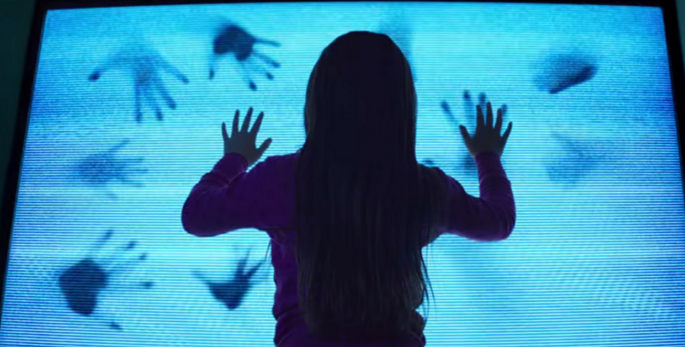
I like Tobe Hooper’s (*cough Steven Spielberg’s cough*) Poltergeist, but I don’t see it as the untouchable classic that many do, and while it has some very cool scenes, I don’t find it a frightening movie for adults. So in comes new the Poltergeist remake, which everyone lambasted from being PG-13 even though the original was PG, and it’s basically the same as the original, which means its target audience is younger viewers. Kenan’s Poltergeist basically follows the first film beat for beat (with the added topical stress of the recession.) The family members have different names, but most of the dynamics remain the same, as does the youngest daughter’s disappearance into the beyond, and her family’s team-up with paranormal investigators to bring her back. It may all be pretty standard stuff, but none of the actors phone it in, and Sam Rockwell’s rascally charm adds some necessary character to the film.

Despite the Poltergeist’s lack of ambition or surprises, it’s a decent, if bland, remake.  Some of the horror elements, one involving a clown doll and another involving a power drill are pretty good for kid’s stuff. The biggest issue comes from the poor CGI which makes the entire film look overproduced and occasionally comical. But there are some design elements in the third act representation of purgatory that serve of reminders of what the film could have been if it had carved its own path.

Scare Factor: 1/5 Poltergeist is not the horrible travesty you may have heard about. It treads the middle-ground of safe and familiar, and for those who haven’t seen the original yet, it may even be a bit interesting. While it’s not memorable, or worth revisiting in favor of the original, for a film that presents itself as a family horror-adventure, it’s just fine. 

Wednesday, October 28, 2015

31 Days of Horror- Day 28: Ouija (2014)

(dir. Stiles White)

Universal Pictures
*First time viewing

After their friend’s apparent suicide, a group of teenagers try to communicate with her through a Ouija board, but they make contact with something else.

Admittedly, my expectations for Ouija weren’t very high. But since a sequel is in the works with Mike Flanagan (of Oculus fame) stepping in as screenwriter and director, I felt I had to see this first entry. The problem with Ouija isn’t the concept. It’s a generic horror movie, with a generic plot consisting of friends getting picked off one by one Final Destination style, but even those kind of movies can be fun. The acting is fine, nothing special (I do love Olivia Cooke, and she tries with what little she’s given.) Even the fact that no one seems to know how a Ouija board works except for the Hispanic housekeeper (because of course) is embarrassingly out-of-touch but not a deal breaker. What makes Ouija such a chore to sit through is that it is entirely devoid of life in everything from its emotional arcs, its dialogue, and most damning: it’s jump scares.

I don’t have a problem with jump-scare centric horror movies, or even PG-13 ones, but Ouija is so PG-13 it hurts. It is entirely incapably of handling any aspect of the film with a maturity deserving of audiences who have seen countless horror films. The way the characters are written to react to the death of their friends and significant others is with such casual disinterest that’s impossible to care about the supposedly life and death horror the film is centered around. The jump scares are so limp that many of them are laughable and telling of how uninterested the film is in pushing boundaries (a rolling shopping cart is one of these “jump-scares”.) After an OK opening, there’s absolutely no sense of tension and as a result the movie just slowly deflates as the actors try their best to hold it up around them.

Scare Factor: 0.5/5 There’s a great horror movie that could be made out of the Ouija board game, but this isn’t it. I’m holding out hope that Flanagan can bring some of his imagination and style to the sequel when it hits next year.